The Witham Sword Inscription: A Structural Analysis Mapping +NDXOXCHWDRGHDXORVI+ within the documented SDX/NDX Christian-invocation tradition. A tripartite structure, a family-typical opener and closer framing an anomalous middle. Not a decoding.
The Witham Sword (British Museum 1858,1116.5), a double-edged knightly weapon recovered from the River Witham in 1825 and dated by the British Museum to c. 1250–1330, carries an inscription of eighteen gold-wire letters whose meaning has resisted scholarly consensus since the first published analysis in 1904. Using an adversarial falsification pipeline, and the documented sword-inscription literature - Wagner et al. 2009 (supplied by the British Museum) and van Hasselt's Alphen-sword family - this work maps the inscription within the documented SDX/NDX Christian-invocation tradition rather than attempting to decode it. The inscription is structurally tripartite: a family-typical SDX opener (NDXOXCH), an anomalous middle (WDRGH) whose support across the documented family is zero and which the documented grammar does not generate, and a family-typical DX “Dominus Xristus” closer (DXORVI). No single Latin plaintext survives testing under any grammar examined. The defensible reading: Witham is a structurally framed, peripheral member of the documented invocation tradition, and its dating to the late end of that tradition (the British Museum's authoritative c. 1250–1330) is consistent with a late, peripheral copy rather than a contemporary core-workshop product. Directly tested, it is an underdetermined invocation-acrostic: the structure is real, the constrained positions are the X (Christus) and the W (a Germanic name), and the unconstrained positions admit too many documented Latin alternatives to privilege any single decipherment. This explains both why the structure looks decodable to multiple readers and why no two readers agree on the decoding. Methodology, findings, falsification conditions, and sources are below.
- Object
- BM 1858,1116.5
- Find
- River Witham, Lincolnshire · 1825
- Date
- c. 1250–1330
- Blade
- Probable German manufacture
- Inscription
- +NDXOXCHWDRGHDXORVI+
- Structure
- Tripartite · peripheral SDX member
- Nearest kin
- W879 · DHM Berlin
- Status
- Provisional · not a decoding
- It maps the inscription's position within a documented tradition. It does not decode it; no unique Latin plaintext survives testing.
- The findings are structural and quantitative, produced by a pipeline that holds a finding only when it passes falsifiability gates and survives adversarial debate.
- The middle (position 7, the letter W) is explicitly the anomaly and is left unresolved; it is not read as a V (Classical Latin had no W, and the inscription uses V elsewhere in …ORVI).
- It does not claim peer-reviewed status, British Museum endorsement, or that adversarial LLM debate constitutes peer review.
The Sword
The Witham Sword is a double-edged steel weapon of the type a medieval knight or wealthy noble would have carried in the 13th century. It was drawn from the bed of the River Witham in Lincolnshire in 1825 and has been held by the British Museum since 1858, catalogued as 1858,1116.5. The blade is of probable German manufacture; the fittings are consistent with English knightly use. Along one face, inlaid in fine gold wire, runs an inscription of eighteen characters: +NDXOXCHWDRGHDXORVI+. The reverse carries a decorative double-scroll pattern according to the British Museum record; no letter inscription on the reverse is documented.
The inscription has been published and debated in Waffen- und Kostümkunde since 1904; the British Library publicly invited solutions in 2015. No proposal has achieved scholarly consensus.
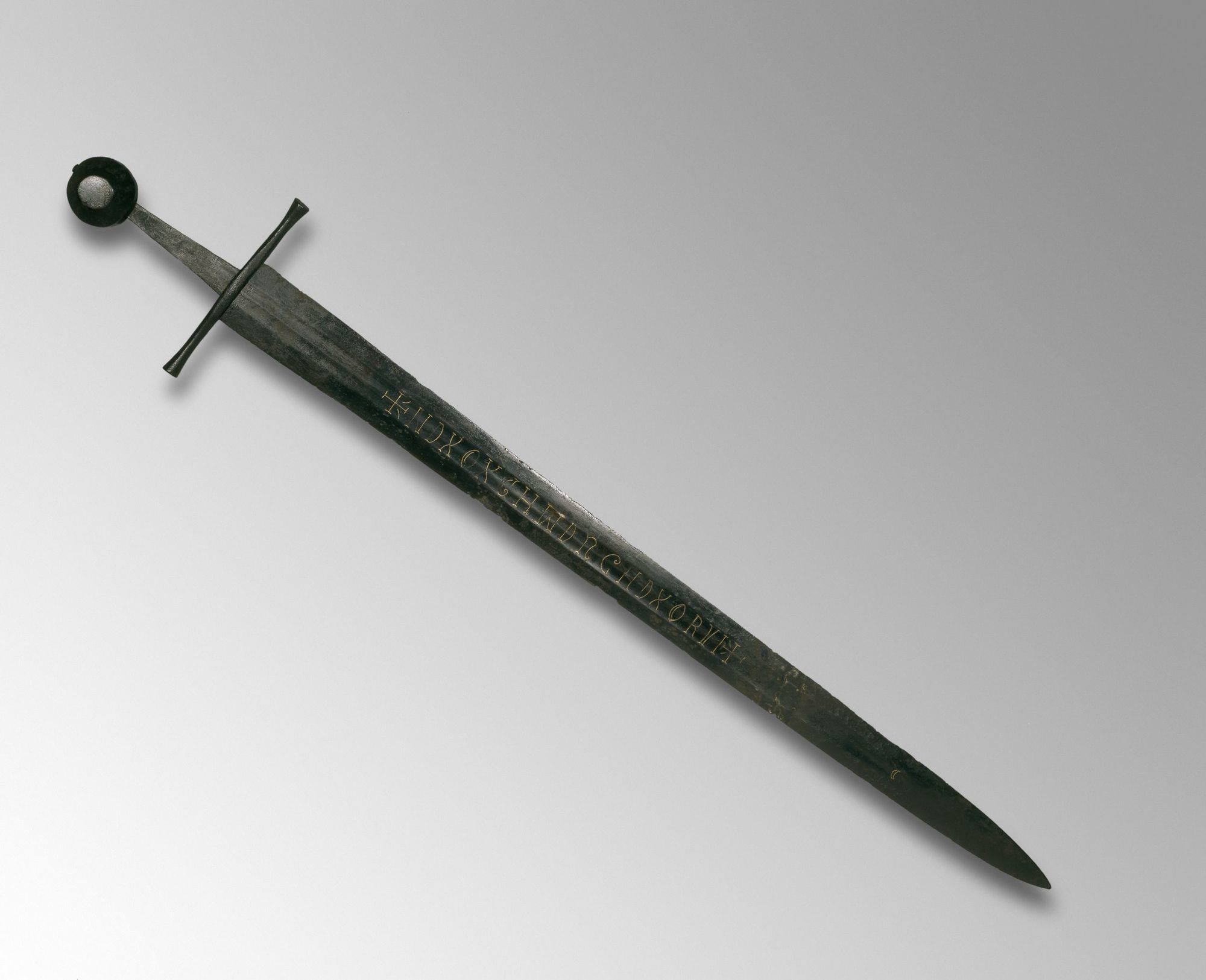
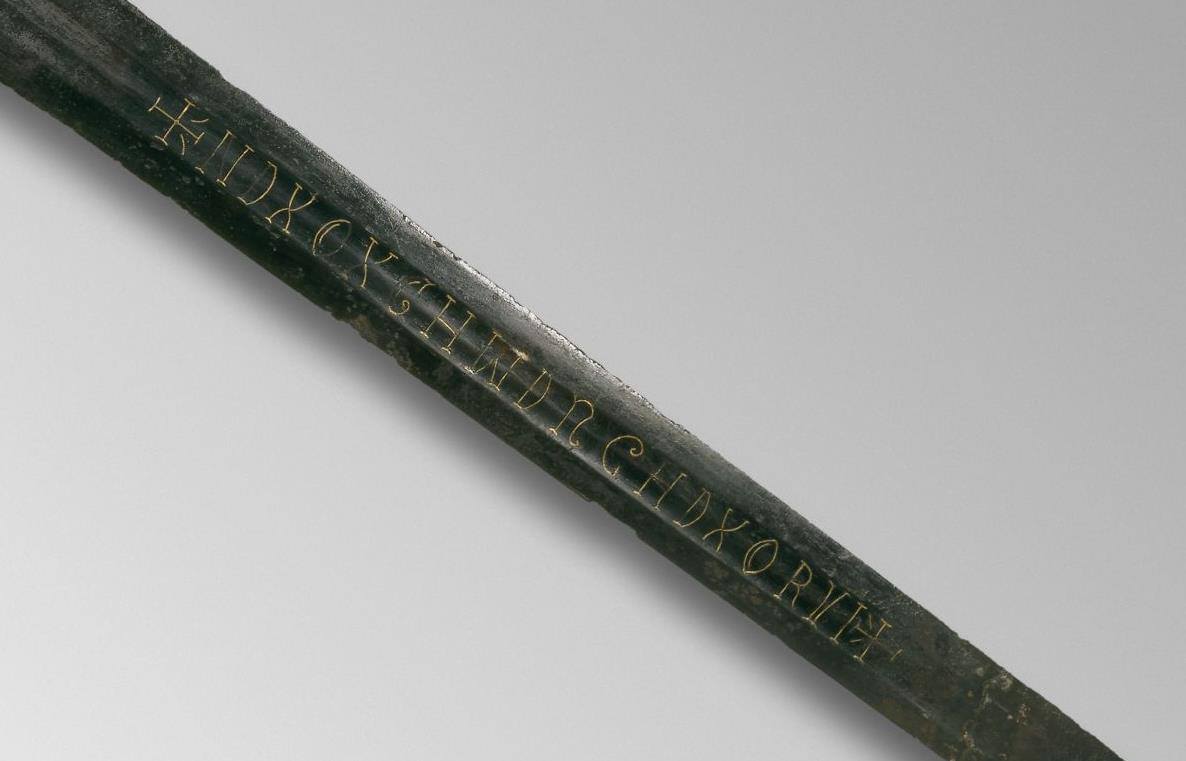
The sword is conventionally dated c. 1250–1330 on typological grounds, a classic knightly weapon of the period, sometimes deliberately deposited in rivers as a votive offering. That late dating places the sword at the tail of the medieval inscribed-invocation tradition, material context consistent with the peripheral-copy reading the statistics return below.
I. The Core Finding
The inscription is not random, not a maker's mark, and not the idiosyncratic invention of a single craftsman. But neither is it a decodable sentence. Read against the documented family, it is structurally tripartite.
The opener and closer align with the documented SDX/NDX invocation grammar; the middle does not, does not produce running text in Latin, German or French, and contains a letter (W) that the documented grammar never generates across 2,000 synthetic inscriptions. The analysis rules out a single recoverable plaintext and rules in family membership at the structural level. The opener/middle boundary is given as approximate: two coverage cuts both hold and are weighed equally, one before the CHW cluster (NDXOX | CHWDRGHDXORVI) and one after it (NDXOXCH | WDRGHDXORVI), and the anomaly lies in the middle on either reading. The interpretation of the middle is left open: an SDX opener and closer with something inserted between them, the inserted material not from the SDX tradition tested.
II. Held Findings
The overarching result is a negative one: no unique Latin plaintext survives testing (720+ iterations, 0 candidates through all gates). What does hold is structural, and it is ranked below by how much each finding bears on the interpretation, foundational findings first, convergent confirmations next, and the many incremental confirmations collapsed at the end.
| Finding | Metric |
|---|---|
| Tier 1 · Foundational each independent; remove one and the reading changes | |
| Methodology control: the same pipeline ranks Karlstad as a core, decodable member and Witham as peripheral, so the verdict is not a tuning artifact. | Karlstad 0.778 vs Witham 0.444 |
| Full-family alignment: Witham's only family-supported positions are the D–X core. | 15 of 18 positions zero support |
| Against a grammar-generated null of 2,000 synthetics, Witham is an outlier on the low side. | 0.0th percentile (mean 0.743) |
| It is initial-abbreviation, not running text in any tested language. | max 0.294 vs running-Latin anchor 0.846 |
| The Roman-numeral density is the dual-use D/X devotional motif, not a hidden number. | within null at 71.3th percentile |
| Directly tested, the inscription is a structured but underdetermined invocation-acrostic: the decode method itself yields no unique reading. | only X (Christus) + the W-name slot constrained · >1011 readings · 5 incompatible decodes |
| Tier 2 · Convergent confirmation independent angles that sharpen the Tier-1 picture | |
| Witham carries the SDX/NDX motif grammar but is a peripheral member, not a core workshop product. | coverage 0.444 · controls 0.333 · core family 0.535–0.870 |
| The anomaly is the middle, not the whole right half: the trailing DXORVI is family-typical. | middle support 0.0 vs 0.40; ORVI 0.5 vs 0.29 |
| The CHW cluster (positions 6–8) is unique to Witham within the documented family. | 0 of 16 catalogued inscriptions |
| The W at position 7 lies outside the documented grammar's productive range. | 0 of 2,000 synthetics contain W or CHW |
| Closest published parallel. | W879 (DHM Berlin) · shared HDXO (len 4) |
| The anomalous middle is robust to transcription error: no single plausible misreading restores family-typical structure, so the anomaly is not a one-letter mistranscription. | 0 of 25 single-char substitutions reach the family band · V/W excluded |
Tier 3 · Incremental confirmations from multiple angles
Beyond the findings above, the pipeline's structural loop has characterized the anomalous middle from many overlapping angles, substring uniqueness (CHW, WDR, WDRG, OXCH, and others), anomaly-region tests across positions 3–11, bipartite splits, and letter frequency. These recapitulate the same fact rather than adding a new claim, so they are collapsed here.
Their convergence is itself the point: five independent test types, substring uniqueness, region anomaly, bipartite split, letter frequency, and full-family position support, all converge on positions 5–10 as the anomalous region centred on the W at position 7.
Two bipartite cuts both hold and are reported equally: a split before the CHW cluster (NDXOX | CHWDRGHDXORVI, coverage gap 0.58) and after it (NDXOXCH | WDRGHDXORVI, gap 0.44). The anomaly falls in the middle on either reading, so the opener boundary is given as approximate.
III. Decode candidates tested and ruled out
The inscription was tested against the documented decode candidates of its period, each with a beat-the-control gate so that a chance partial match cannot pass. None fits. The result is therefore not “we could not decode it” but “every documented decode candidate of the period was tested, and none accounts for the inscription.”
- Canonical prayer initialisms. Not the initial letters of the Pater Noster, Ave Maria, Credo, Gloria Patri, Christus Vincit, Te Deum, Salve Regina, In Nomine Domini, or Psalm 43/44. The best contiguous alignment with any prayer's initials is 2 letters, below what the documented family members reach.
- Standard abbreviations (nomina sacra). Not composed of the standard medieval abbreviations DS, DNS, XPS, IHS, SPS, SCS; these cover none of the anomalous middle.
- Apotropaic formulae. Not one of the documented protective formulae of the period: the Three Kings (Caspar, Melchior, Balthasar / C-M-B), the SATOR square, AGLA, or ANANIZAPTA.
- Running text. Not running text in Latin, German, or French; it scores far below a validated running-Latin control.
- Number or date. Does not encode a date or regnal year; its Roman-numeral density sits within the grammar-generated null, the dual-use D/X devotional motif rather than a hidden number.
- Maker, title, order, charm. The right portion is not a documented maker signature, noble-title abbreviation, or religious-military order formula.
- Cipher. No Caesar shift unlocks family-grammar structure.
- Transcription error. The anomaly is robust to plausible single-character misreadings: 0 of 25 substitutions restore family-typical structure.
Beyond the fixed formulae above, we also tested the general decoding method the public effort applies, reading the inscription as the initial letters of a Latin invocation:
- The acrostic method itself is underdetermined. Under a source-audited vocabulary restricted to documented devotional and titulature Latin (Vulgate, liturgy, Laudes Regiae, attested medieval titulature and onomastics; classical Latin words without devotional or titulature use were excluded), only the X positions are constrained, to Christus, and the W position is constrained to a Germanic name, which is why every reader reaches for “a William.” Every other position admits several documented words, giving a conservative lower bound of more than 1011 valid initial-letter readings; a broader attested vocabulary only raises this, and tightening it does not change the conclusion. The inscription is therefore an underdetermined acrostic: the structure is real, but no single reading is recoverable from the letters. This is why at least five independent readers (van Hasselt, Crofts, Cox, Rapallo, Hedlund) produced five mutually incompatible decipherments, all grammatical, all invocation-templated, none agreeing beyond X=Christus and W=a-name. Falsification condition: a tighter source-audited vocabulary, restricted further than the one used here, that reduced the readings to a single uniquely-fitting candidate would refute this finding in favour of that candidate; producing such a vocabulary, with sources, is how to attack it.
- The Willem II reading specifically does not fit. The most specific public decipherment, Stieg Hedlund's identification with Willem II of Holland (“Comes Hollandiae Willelmus Dei gratia Rex Germaniae...”), fails under consistent initialisation: initialised one letter per word it yields CHWDGRGEHDN, not the inscription's CHWDRGHD. It matches only by omitting three function words from initialisation (the “gratia” in “Dei gratia,” the “et,” and the “nutu” in “Dei nutu”), an inconsistent rule: if function words can be silently dropped, the acrostic admits far more readings than the Willem II identification claims to privilege.
These public readings are amateur or informal (blog posts, discussion-forum comments), not peer-reviewed; the academic community has not engaged with them. This is not a dismissal. The convergence on “the W is a name” and “the closer is the Laudes Regiae” is real and reflects the genuine constraints on those positions; what the convergence cannot do is privilege any specific reading, because the unconstrained positions admit too many alternatives. The competing decipherments are not refuted as ignorant, but as overfit.
What remains: the opener and closer are family-typical SDX invocation grammar; the anomalous middle is a non-SDX, underdetermined name/invocation acrostic whose only firmly constrained letters are X (Christus) and W (a Germanic name). Its specific content is not recoverable from the letters.
Explore the underdetermination
Read as an initial-letter acrostic, each position is a slot to be filled by a Latin invocation word. Click any letter to see the documented candidates for that slot. Only two slots are fixed; the rest are open, and that is the whole argument.
IV. Methodology
A four-move architecture, beyond falsification alone.
Falsification. Hypotheses pass four gates: significance (α = 0.05), effect size (Cohen's h > 0.3), beats-controls (the target must be distinguishable from secular control inscriptions), and adversarial-debate survival (advocate, adversary, arbiter on independent model tiers). Candidates failing any gate are refuted. In plain language: a candidate is held only when its match to the inscription is too strong to be chance (p < 0.05), too large to be trivial (Cohen's h > 0.3), distinguishable from non-semantic controls, and able to survive adversarial critique by independent reasoning models.
Abduction. A structural-mode loop generates falsifiable structural claims (substring uniqueness, nearest kin, anomaly regions) and holds those that pass objective tests against the family corpus.
Triangulation. Independent angles (statistical, material, paleographic) are recorded separately; convergence strengthens a finding. Two of the three converge here: the statistical reading and the material/dating evidence both point to a late, peripheral member. The paleographic angle (letterform autopsy of position 7, the W) remains pending, autopsy-grade imagery of the blade is rights-restricted and has not yet been analysed, so this third leg is openly marked incomplete rather than asserted.
Generative testing. Synthetic SDX inscriptions are generated from the documented grammar to provide a null distribution, so the target is compared against the grammar's full productive range, not only the few surviving real comparanda.
V. The Corpus
The pipeline operates over a verified corpus. Every entry is sourced to a published paper or a museum record; no entry is seeded from the target, and no inscription is asserted as a verbatim match to Witham.
| Sword | Find location · date | Relationship to Witham | Source |
|---|---|---|---|
| WITHAM_01 ★ | River Witham, Lincolnshire · c.1250–1330 | target | BM 1858,1116.5 |
| KARLSTAD_01 | Värmlands Museum · c.12–13th c. | core SDX member with a worked reading | Wagner 2009, pl.12–13 |
| W879_01 | DHM Berlin · c.12–13th c. | nearest published parallel (shares HDXO) | Wagner 2009, pl.23 |
| W897_01 | DHM Berlin · c.12–13th c. | SDX family | Wagner 2009, pl.14 |
| MARBURG_01 | Marburg · c.12–13th c. | SDX family | Wagner 2009, pl.24–25 |
| UMFB74_01 | Museum Gustavianum (Fyris) · c.12–13th c. | SDX family | Wagner 2009, pl.17 |
| RADHUS_01 | Stockholm (Fyris) · c.12th c. | running-Latin control (+INNOMINEDOMINI+) | Wagner 2009 |
| ALPHEN_01/02 | Alphen aan den Rijn, NL · c.1200 | international family - related, not identical | van Hasselt |
| ULFBERHT_01 | Rhineland · c.9–11th c. | tradition reference | Oakeshott 1991 |
| OSOSOSOS_01 · NMRNMRN_01 | typological | secular / non-semantic controls | - |
VI. What This Does Not Claim
- It does not claim a Latin plaintext expansion for the inscription. As of the analysis run dated 20 May 2026, across 720+ iterations on two adversarial teams with four-gate filtering and two model tiers, zero candidates passed all gates.
- It does not claim the V/W substitution reading. The British Museum curator (D. Whitewood, personal communication, 2026-05-18) noted that Classical Latin had no W, that the inscription uses V elsewhere (…ORVI), and that this latter fact alone closes the substitution reading: if W and V were interchangeable, there would be no reason for the engraver to have chosen W.
- It does not claim a reverse-side inscription; the British Museum record describes the reverse as a decorative double-scroll.
- It does not claim Witham is verbatim matched by any other documented sword.
- It does not identify the tradition the anomalous middle comes from; that middle does not align with the SDX tradition tested.
VII. Outstanding Items
- High-resolution blade imagery for paleographic analysis of the letterforms, particularly position 7 (the W), required to complete the triangulation third angle. It would also let the transcription-robustness test use the actual strokes rather than the generic letter-shape classes it currently relies on.
- Confirmation from the British Museum on the reverse-side documentation and the dating of the blade.
- Identification of the tradition, if any, behind the anomalous middle (positions 7–11): documented maker signatures, noble-title abbreviations, military-order formulae, or amulet acronyms are the next comparison set.
Field Session — Close-Range Observations
In a recent close-range examination of the blade at the British Museum, we read the letterforms as seen, deliberately not "correcting" them toward the traditional transcription. Three things stood out that the online catalogue does not record — none a solution, all of them testable.
- The
Xmay not be a letter. It is drawn as an hourglass "bowtie" and sits in a rhythm of raised dot-dividers —X · O · X— with some O’s carrying a central dot. That suggests the X may be punctuation or ornament separating words, not a spoken letter. If so, the celebrated “OXO cluster” is really a framed O, and the whole string has probably been divided up wrongly for two centuries. - A worn junction reads as either
GHorCH. Exactly where the gold is most lost, the traditional GH may in fact be CH — which would mean a short group is repeated along the blade: a short prayer stamped twice rather than one long unique text. - A crescent “lunette” mark and extra dots near the tip that the standard reading does not mention at all. If they are genuine, the accepted end of the inscription (
…DXORVI+) is incomplete.
The decisive test is whether the bowtie-X is flanked by dot-dividers at every occurrence — the feature that settles letter-versus-divider and, with it, how the entire inscription should be segmented. We have secured a close-range study-room appointment at the British Museum to examine exactly this under raking light, together with the worn GH/CH junction and the crescent mark near the tip. We will report what the light shows — including if it shows our own leads to be wrong.
VIII. Sources
- Wagner, T., Worley, J., Holst Blennow, A., Beckholmen, G. (2009). Medieval Christian invocation inscriptions on sword blades. Waffen- und Kostümkunde 51(1): 11–52.
- van Hasselt, M. Een mysterieus zwaard uit Holland. Roman Museum, Alphen aan den Rijn.
- Oakeshott, E. (1991). Records of the Medieval Sword.
- British Museum object 1858,1116.5; personal communication, D. Whitewood, 2026-05-18.